

What the Back of a Brooch Tells You
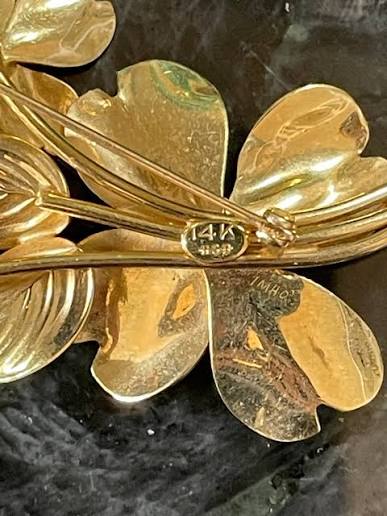
Most jewelry keeps its secrets. Brooches do not, because the mechanism holding them closed has changed repeatedly over the last two centuries, and each change is datable. Anyone examining vintage pins and brooches should turn the piece over before looking at the front, since the hardware often establishes the period more reliably than the design does. Styles were revived and copied constantly. Clasp mechanisms were driven by patents and manufacturing, and they moved in one direction.
Reading the pin stem
Start with the pin itself and where it sits.
On genuinely early pieces, roughly pre-1890, the pin stem commonly extends noticeably beyond the edge of the brooch body. This was practical: the heavy fabrics of the period needed a long stem to grip. A stem sitting flush within the frame suggests later manufacture.
The hinge matters too. Early brooches typically used a simple tube hinge, a small rolled cylinder soldered to the back. Later work moved toward more refined hinge assemblies.
The clasp sequence
This is the useful part, because the progression is broadly chronological.
C-clasp. A simple open hook that the pin rests inside, with nothing securing it. Standard through most of the nineteenth century and into the early twentieth. It has no locking mechanism at all, which tells you something about how carefully these pieces had to be worn.
Trombone clasp. A tube that pulls outward to release the pin and pushes back to secure it, named for the sliding action. Largely European, common from the late nineteenth century into the early twentieth.
Safety catch. The rotating or hinged cover that swings over the pin point. Broadly a twentieth-century development that became standard, and the mechanism most people picture when they think of a brooch closure.
Two cautions. Clasps get replaced, particularly on well-loved pieces, so a modern safety catch on an older brooch may indicate repair rather than recent manufacture. Look for solder evidence and whether the catch matches the surrounding metal in color and wear. And these are indicators rather than proof. Use them alongside the metal, the stone cuts, and the construction, not instead of them.
What the metal work adds
Look at how the back is finished. Period brooches were frequently hand-assembled, and the reverse shows it: solder joins with slight irregularity, hand-cut openings behind stones, and settings that were closed individually rather than in a single operation.
Open backs behind transparent stones generally indicate a maker confident in the material and interested in letting light through. Closed backs are common on earlier pieces and on anything foil-backed, where a reflective layer sits behind the stone. If you find a closed setting, keep it dry, since moisture reaching foil corrodes it and permanently clouds the stone.
Hallmarks vary enormously by country and period. British pieces are the most systematically marked; American work of the same era frequently carries only a metal designation, or nothing at all. An absence of marks is not evidence of anything much.
Condition on a piece designed to be pierced through fabric
Brooches take a specific kind of wear. Check four things.
The pin stem should be straight and springy, not bent or slack. A stem that no longer holds tension will open in wear.
The hinge should move cleanly without lateral play.
The catch should close positively and stay closed under light pressure.
And check the solder joins around the fittings, since these are the points that take the stress every time the piece is worn.
All four are repairable. None should be a surprise after purchase, and a good dealer will have noted them already.
Why they are worth looking at
Brooches have been undervalued relative to rings for decades, largely because fewer people wear them daily. That means the workmanship available at a given budget is often considerably better than what the same money buys in a ring, and it makes them an unusually good entry point for anyone starting to collect period jewelry seriously.
They are also among the most giftable pieces in estate jewelry, since they carry no sizing problem at all.
If you would like to see how period pieces are examined and their condition described before sale, browse the current collection at Gesner Estate Jewelry, where each item is hand selected and evaluated. Turn it over first. The back is where the piece tells you the truth.