


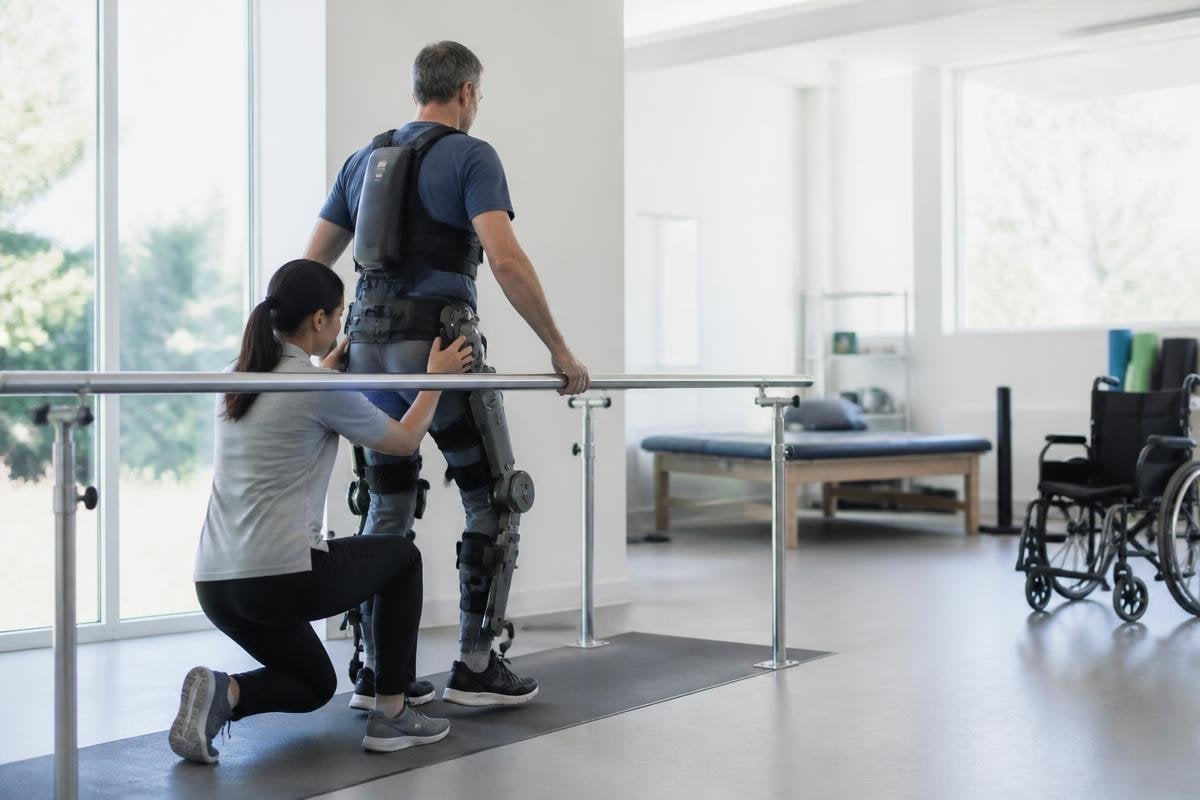
A rehabilitation exoskeleton can support a person’s legs or trunk while they practise a movement. That may change how a session is delivered, but it doesn’t turn walking into a solved problem. The value depends on fit, training goals, therapist control, and evidence for the specific device.
- Assisted steps can give a person more practice during a session
- Sensors can adjust support as movement changes
- Clinical gains still need proof from measured patient outcomes
What the machine does
An exoskeleton uses powered joints, sensors, and a control system to help guide movement. A leg system may assist the hip, knee, or ankle as the person shifts weight and takes a step.
That support can reduce the effort needed for part of the movement. It may also give the therapist a way to repeat the same task with a chosen level of assistance, rather than lifting or guiding the person by hand each time.
The control system matters because the robot must respond to the person, not move on a fixed track. Sensors can detect joint position, force, or changes in balance. The system then adjusts the motor output within its programmed limits.
A patient still has to take part. The exoskeleton can guide a leg, but it can’t decide whether the person is ready for more weight, less support, or a different exercise. That decision stays with the clinical team.
Why repeated practice matters
Walking recovery depends on practice, yet practice can be hard when a person has weak muscles, poor balance, pain, or limited control on one side. A device that supports part of the task may let the person repeat a movement with less physical help from staff.
The useful measure is not how much the robot moves. It is what the person does during and after training. A session may be productive if the patient takes more active steps, controls more of the motion, or needs less support over time.
Those outcomes need clear tests. Clinicians might track walking speed, step control, balance, range of motion, or the amount of help needed for a task.
A device can produce smooth steps during training and still fail to improve daily movement. The machine’s performance and the patient’s progress are separate questions.
A rehabilitation claim needs the trial setting, training task, date, and measured result beside the device. Rehabilitation robotics coverage from Robot24.com can connect those facts to named exoskeletons before the next section examines where the machines stop helping.
Where the limits sit
Fit is one limit. The frame must match the person’s body and movement pattern, and the straps must stay secure without causing discomfort. A poor fit can change the exercise or make the session harder to manage.
Safety adds more work. A clinical team needs a clear stop method, close supervision, and a plan for loss of balance, power failure, or a sensor error. The room also needs enough space for the person, the device, and the staff member who is helping them.
Training time matters too. Staff need to learn how to fit the frame, select support settings, check the person, and record results. If setup takes too long, the patient may spend less time practising. That can cancel out the value of the device.
Cost and access shape the result. A clinic may need the exoskeleton, maintenance, software updates, staff training, and a suitable treatment area. Without those pieces, the purchase price tells you little about the full burden.
The largest open issue is transfer. A person may move well with powered support and still struggle when the device is removed. I’d judge an exoskeleton by the patient’s unassisted movement, not by a smooth session inside the frame.
A clinic’s buying checklist
Before a clinic considers a rehabilitation exoskeleton, the team should:
- Define the task: name the movement the device must support and the patients who need it.
- Check the evidence: ask for measured outcomes from a patient group that matches the clinic’s work.
- Test the fit: include body-size limits, adjustment time, comfort, and access for clinical staff.
- Plan the session: record who operates the system, how support changes, and how progress is measured.
- Price the full setup: include training, service, software, storage, and room changes.
- Set a stop rule: decide what result would lead the clinic to pause or end the program.
A sensible purchase therefore starts with a treatment goal, not a robot specification. Ask how the device will increase useful practice, how the team will measure carryover, and what happens when the motors stop helping.
The next step for rehabilitation exoskeletons is clear: clinics need device-specific patient results that connect assisted training with movement outside the frame.