

Teen Dancewear: Choosing Pieces That Support Confidence Through the Adolescent Years
Something shifts around age twelve or thirteen. A dancer who never gave a second thought to what she pulled on for class starts adjusting her leotard in the mirror, asking whether she can wear shorts over it, or finding reasons to keep a warm-up layer on well past the point of being warm. Parents and studio directors often read this as vanity or distraction. It is neither. Selecting teen dancewear well means recognizing that a dancer who feels exposed in a mirrored room is spending attention on her clothing that should be going toward her training.
The solution is rarely a conversation about confidence. It is usually a wardrobe adjustment.
Why the Teen Years Change the Conversation
Adolescence brings rapid and uneven physical change, and dance places that change under unusual scrutiny. Studios are built around mirrors. Corrections are given about line and alignment. Dancers stand in close proximity in fitted clothing for hours at a time.
A dancer navigating a growth spurt, a shifting center of gravity, and a body that looks different month to month is managing a lot at once. Clothing that feels secure removes one variable. Clothing that feels revealing adds several.
This is not a matter of accommodating self-consciousness at the expense of training. It is the opposite. Comfort in the studio is a precondition for full participation, and dancers who are physically at ease take corrections better, move more freely, and quit less often.
Coverage Options That Work Within a Dress Code
Most dress codes leave more room than families assume. The useful move is to identify where the code is specific and where it is silent.
Shorts and briefs worn over a leotard are the most common addition and are permitted in most classes outside formal ballet technique.
Higher-back and higher-neckline leotards provide meaningful coverage while remaining fully code-compliant in color and silhouette. A dancer who feels uncertain about an open back will often be entirely comfortable in the same color leotard with a different back design.
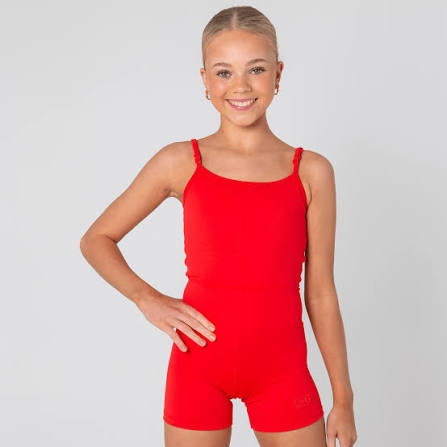
Unitards solve the coverage question in a single garment and have become standard for contemporary and commercial work. They also photograph and film cleanly, which matters for audition submissions.
Leggings and fitted joggers over a leotard work well for rehearsal blocks and warm-ups where the code allows.
When a studio’s code is strict, a direct conversation with the director is worth having. Most are receptive to a request framed around a dancer’s comfort, and many have already had the same conversation with other families.
Fit Problems That Are Actually Sizing Problems
A significant share of complaints about a leotard feeling revealing come down to poor fit rather than design.
The measurement that causes the most trouble is torso length, sometimes called girth, taken from the shoulder down through the body and back up. Teen dancers often develop long torsos before their chest and hip measurements catch up. Sizing by bust or hip alone produces a garment that rides up, pulls at the shoulders, and cuts high at the leg opening. The dancer concludes the style is wrong when the size was.
Look for brands that publish torso measurements. Have the dancer raise both arms fully overhead during a fit check. If the garment rides up sharply or the shoulders pull down, the torso length is short regardless of what the other numbers say.
Letting Teens Lead the Decision
The practical shift in these years is who chooses. A dancer old enough to notice how she feels in a garment is old enough to select it.
Set the parameters clearly, meaning the dress code, the budget, and the number of pieces, then let her choose within them. This produces better outcomes than negotiating item by item, and it removes the parent from the position of arbitrating what does or does not look appropriate, which is a conversation that rarely ends well at fifteen.
What to Buy When Sizes Are Still Moving
Avoid stockpiling during active growth years. Build a working rotation of three or four leotards, four to six pairs of tights, a couple of coverage layers, and one piece reserved for performances and auditions.
Reassess fit every few months. Buying fewer, better-constructed pieces and replacing as needed costs less across a year than buying volume that stops fitting in March.
Signals Worth Noticing
A dancer who keeps a warm-up jacket on through center work, positions herself at the back of the room, or resists certain classes may be telling you something about her clothing rather than her commitment. Ask directly, without framing it as a problem to be solved. The answer is often simple and the fix is often a single purchase.
Getting Started
Teen dancers train harder when they are not managing discomfort. Confirm the dress code, check torso sizing carefully, add coverage where the code allows, and hand the final choice to the dancer. Tiger Friday designs with these realities in mind, offering fits and coverage options built for dancers in exactly this stage. Explore the range to find pieces that let your dancer focus on the work.